
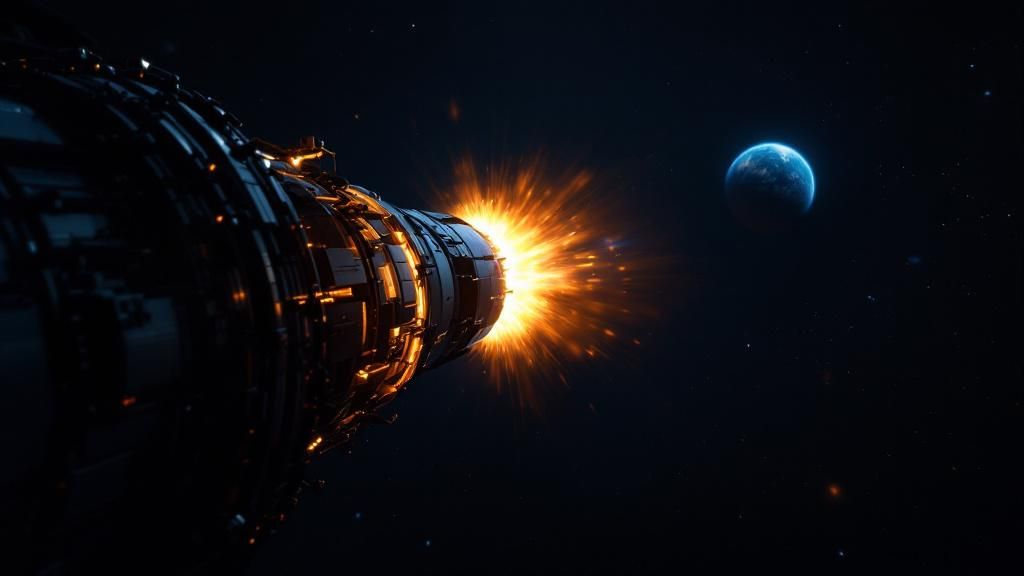
Four astronauts aboard the Artemis II mission have successfully broken free from Earth’s gravitational pull after their Orion spacecraft executed a crucial engine burn on its path to the Moon. The translunar injection manoeuvre, lasting five minutes and 55 seconds, went smoothly according to NASA officials, propelling the crew farther into space than any humans have ventured since the Apollo era concluded in 1972. Canadian astronaut Jeremy Hansen, speaking from the capsule as Earth receded behind them, reported the crew were “feeling pretty good” as they set out on their historic journey. The spacecraft is now set on a curved trajectory that will carry the four explorers around the Moon’s far side and back to Earth, marking humanity’s triumphant return to deep space exploration after over 50 years.
The Essential Engine Burn That Transformed Everything
The translunar injection represented the mission’s crucial moment, a meticulously planned manoeuvre that would dictate whether Artemis II could escape Earth’s gravitational pull. Behind the crew’s seats, the Orion service module activated its main thruster in a prolonged, continuous burn that boosted thousands of kilometres per hour to the spacecraft’s momentum. NASA’s Dr Lori Glaze confirmed the burn proceeded “flawlessly”, a testament to years of careful preparation and refinement. This was far more than another engine firing—it was the gateway to the lunar realm, the point at which the crew’s trajectory moved away from orbiting Earth to heading towards the Moon itself.
What made this burn particularly significant was its irreversibility in practical application, yet NASA engineers had built in multiple safety margins. Orion programme manager Howard Hu noted that controllers retained the ability to execute an emergency “handbrake turn” in space within the first 36 hours, permitting the crew to make it home if something went seriously wrong. Beyond that window, remaining on course around the Moon became the fastest and often simplest route home. The team had conducted hundreds of thousands of simulations to safeguard the crew, turning what could have been an nerve-wracking occasion into a carefully choreographed success.
- Engine burn lasted 5 minutes 55 seconds precisely
- Increased thousands of km/h to spacecraft velocity
- Abort protocols available during first 36 hours
- Hundreds of thousands of test scenarios conducted in advance
Plotting an Remarkable Journey Across the Universe
With the translunar injection complete, Artemis II has embarked upon a trajectory that will carry the crew farther into space than any human has travelled previously. The spacecraft is now committed to a looping path that will arc the four astronauts around the Moon’s far side and returning to Earth, a journey expected to take them more than 4,700 miles beyond the lunar surface. This bold trajectory represents a precisely computed balance between exploration and safety, allowing NASA to test Orion’s systems in the most demanding environment whilst maintaining multiple contingencies should anything go awry during the mission.
As Earth progressively fades to a pale blue dot on the livestream from Orion, the crew witnesses the stark reality of their departure from home. The spacecraft’s engines, navigation systems and life-support mechanisms have all been rigorously inspected during the preliminary high Earth orbit phase, confirming each element performs perfectly. Now, surging through empty space at unprecedented speeds, the four explorers exemplify our persistent yearning to push beyond known boundaries and restore our position among the stars after prolonged separation from deep space exploration.
Beyond Apollo’s Heritage
The trajectory Artemis II will pursue threatens to eclipse the distance record established by Apollo 13 in 1970, a mission that gripped global imagination during its dangerous lunar swing. Depending on the specific timing and trajectory adjustments, the Orion capsule could travel significantly further from Earth than the Apollo spacecraft achieved half a century ago. This achievement holds profound symbolic weight, representing not merely a technical achievement but a renewal of humanity’s commitment to discovery and exploration in the cosmic realm.
Canadian astronaut Jeremy Hansen, the first non-American to venture to the Moon, captured the momentous nature from his vantage point aboard Orion. He noted the collective effort of many engineers, scientists and mission specialists whose commitment made this occasion possible. His words—”Humanity has once again shown what we are capable of”—resonated across mission control centre, a striking affirmation that space exploration remains fundamentally an endeavour that unites nations and generations in collective purpose.
Safety Measures and Backup Plans
Despite the significant achievement of leaving Earth’s orbit, NASA has confirmed that Artemis II remains well away from a point of no return. Mission controllers have the means to execute what programme manager Howard Hu describes as “the equivalent of a handbrake turn in space,” allowing them to guide Orion back towards Earth should any significant problem emerge during the mission. This safety-focused strategy reflects extensive lessons learned from previous space programmes, where careful planning and redundant systems have consistently proven the difference between triumph and tragedy in the unforgiving environment of deep space.
The team’s belief in these contingency protocols stems from exhaustive preparation. Howard Hu explained that NASA has executed hundreds of thousands of simulations to verify every possible crisis situation and action plan. In the crucial 36-hour period right after the translunar injection burn, a quick turnaround represents the fastest route home. Beyond that period, flight controllers have established that proceeding around the Moon and allowing Earth’s gravity to recapture the spacecraft often proves equally swift and operationally simpler, providing the crew with numerous feasible routes to safety.
| Emergency Scenario | Response Time |
|---|---|
| Critical system failure within 36 hours post-TLI | Immediate U-turn manoeuvre available |
| Life-support system malfunction | Contingency protocols activate within minutes |
| Navigation system degradation | Ground control assumes manual guidance |
| Emergency after lunar orbit insertion | Lunar gravity-assist return trajectory engaged |
- Orion’s failsafe systems maintain ongoing oversight of all critical functions
- Mission control sustains immediate contact and decision-making authority throughout
- Multiple abort scenarios have been extensively drilled with complete team involvement
The Stunning Views Greeting the Space Explorers
As the Artemis II crew continues their journey beyond Earth’s orbit, they are witnessing vistas that have stayed mostly hidden by human eyes for more than five decades. From the windows of the Orion capsule, Earth itself is gradually diminishing into the cosmic distance, a sobering viewpoint that only a handful of individuals have ever experienced. The livestream transmissions reveal our planet progressively getting smaller as the spacecraft accelerates deeper into space, a touching testament of humanity’s vulnerable position within the vastness of the universe. Canadian astronaut Jeremy Hansen and his crewmates are fortunate witnesses of this remarkable shift from terrestrial existence to deep space exploration.
The voyage ahead delivers even more breathtaking sights as Artemis II follows its arcing path around the lunar far side. The crew will observe the Moon in extraordinary precision as they swing beyond its edge, attaining distances that will go beyond the Apollo 13 record established over five decades earlier. This path will propel them over 4,700 miles beyond the lunar surface, granting perspectives of both the Moon and Earth that hardly anyone has seen. The combination of scientific study and genuine awe defines this historic moment, as the astronauts encounter the splendour of cislunar space firsthand during humanity’s successful comeback to lunar exploration.
A Heavenly Show Takes Place
The spectacular sight in store for the Artemis II crew extends far beyond simple tourism. As they travel along their extended trajectory around the Moon’s far side, the astronauts will witness the Moon’s surface in remarkable clarity whilst simultaneously witnessing Earth as a distant blue sphere set against the endless darkness of space. This dual perspective—the stark, cratered lunar surface contrasted against our home planet fading into the distance—captures the deep importance of this mission. These observations will not only provide invaluable scientific data but will also give humanity a fresh visual testament to our remarkable human capacity for exploration and discovery.
What This Endeavour Means for Humanity’s Future
The successful translunar injection marks a pivotal juncture in human spaceflight, signalling that we have genuinely returned to deep space exploration after a fifty-year hiatus. Jeremy Hansen’s words from the Orion capsule—”Humanity has once again shown what we are capable of”—resonate with deep meaning, informing us that such accomplishments require unwavering dedication and collective perseverance. This mission demonstrates that the technical capability and organisational skill required for exploration of the moon remain not merely preserved but have evolved substantially since the Apollo era. The flawless execution of the TLI burn, managed by flight controllers who have conducted hundreds of thousands of simulations, highlights the careful preparation and skill that underpins contemporary space exploration.
Beyond the immediate scientific objectives, Artemis II constitutes a crucial stepping stone towards establishing long-term human occupation outside Earth’s orbital space. The mission’s emphasis on crew safety—with backup protocols allowing rapid return to Earth if necessary—demonstrates how spaceflight has matured as a field. This voyage around the Moon will deliver invaluable data and insight essential for upcoming Moon landings and eventual missions to deep space. As Hansen remarked, “It’s your hopes for the future that carry us now on this journey around the Moon,” expressing the visionary drive driving this undertaking and its potential for generations to come.
